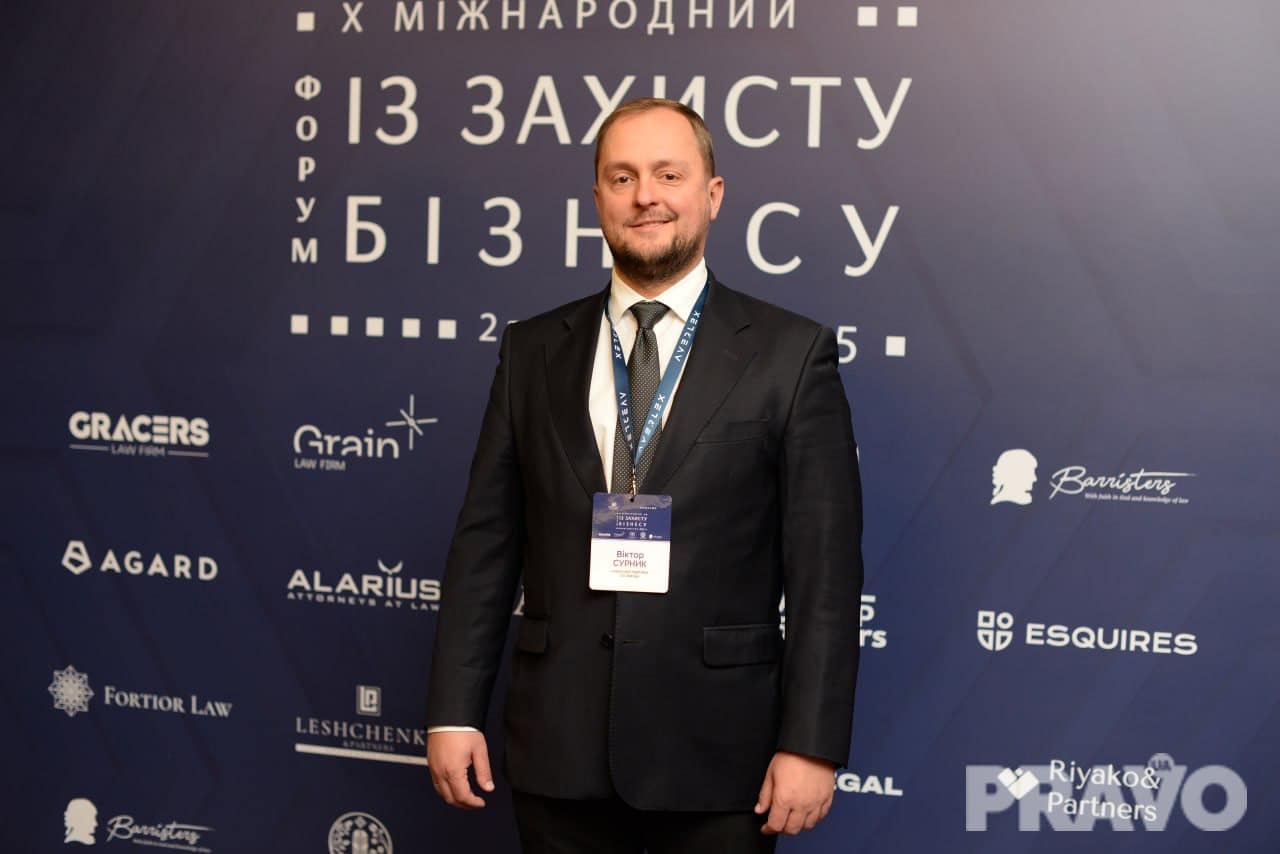
War is no longer a “universal excuse” in treaty disputes. The CCP certificate is only a proof, not a guarantee, and after the abolition of the Commercial Code, the rules of the game for business have finally changed. Current legal practice, real cases and advice on how to properly lay force majeure and risks in contracts in the new legal reality - in the material of Viktor Surnik, Managing Partner of Alarius AO, for the special project “TOP-50 Leading Law Firms of Ukraine 2026"
The war changed not only the economy of Ukraine, but also the legal guidelines of business. If in 2022—2023, businesses still hoped for a “magic certificate” from the Chamber of Commerce and Industry (CCI), then in 2025 it became obvious that force majeure does not save everyone. Courts are increasingly meticulous in considering each case, and lawyers have to build arguments not on emotions, but on evidence and clear contractual mechanisms.
New context:
War and Absence
Economic Code of Ukraine
Since August 28, 2025, the Economic Code (Civil Code) of Ukraine has ceased to be effective in accordance with Law No. 4196-IX of January 9, 2025. From now on, the regulation of relations between business entities is carried out on the basis of the Civil Code (Civil Code) of Ukraine and special laws.
According to practicing lawyers, this significantly influenced the approaches to the analysis and preparation of contracts.
The concepts of “commercial contract” and “economic and legal responsibility” are gradually disappearing from practice. However, the crux of the problem remains: the war continues to create situations where the implementation of the treaty becomes objectively impossible.
In which cases the war —
not automatic force majeure?
Under martial law, businesses often face supply delays, destruction of warehouses, and mobilization of workers. But all this does not mean automatic exemption from liability under this or that contract.
The Economic Court of Cassation as part of the Supreme Court in its decision of June 7, 2023 in case No. 906/540/22 concluded that “the letter of the CCP dated February 28, 2022 No. 2024/02.0-7.1 is not an unconditional basis to consider that force majeure has occurred for all subjects without exception. Each subject who, due to certain circumstances, cannot fulfill his obligations under a separately specified contract, must prove that he has force majeure circumstances. It is the court, on the basis of the evidence available in the material, that must determine whether the circumstances referred to by the party are indeed extraordinary and inevitable, which objectively make it impossible for the party to perform its duty properly.”
So the certificate of the Chamber of Commerce and Industry is only one of the proofs, but not a guarantee of victory in the dispute. The courts check:
— whether the event was extraordinary and inevitable;
— whether it has made it impossible for this party to fulfill the obligation;
— whether all possible measures have been taken to minimize the consequences.
Force majeure is a significant change
Circumstances and economic
impossibility: a new look
The decision of the Economic Court of Cassation of July 21, 2021 in case No. 912/3323/20 gives a clear understanding of these concepts and their differences.
Force majeure (circumstances of force majeure) are extraordinary and inevitable circumstances that objectively make it impossible to fulfill obligations stipulated by the terms of the contract (contract, agreement, etc.), obligations under legislative and other regulatory acts (part 1 of Article 617 of the Civil Code of Ukraine, part 2 of Article 218 Civil Code of Ukraine and Article 14-1 of the Law of Ukraine “On Chambers of Commerce and Industry in Ukraine”).
Extraordinary circumstances are those circumstances, the occurrence of which is not expected by the parties in the ordinary course of affairs. Extraordinary circumstances can be called the occurrence of which a conscientious and reasonable participant in the legal relationship could not have expected and foreseen, although he showed a sufficient degree of prudence.
Circumstances are inevitable, the occurrence of which the participant in the legal relationship could not prevent, nor could he prevent the consequences of such circumstances, even with the proper degree of prudence and the application of reasonable measures to prevent such consequences. The key is that force majeure makes the fulfillment of the obligation impossible in principle, regardless of the effort and material costs that the party has made or could have made, and not only those that cause difficulties or are economically disadvantageous.
As for the economic impossibility, the Economic Court of Cassation in its ruling in case No. 910/6493/23 of July 30, 2024 refused to accept the economic arguments referring to the tariff change, noting that the defendant, at the time of signing the contract, had to assess the possibility of its implementation. Therefore, the reference to the increase in the tariff, which was known at the time of the conclusion of the contract, does not exempt from liability.
“The Economic Court of Appeal, referring to the legal position of the Supreme Court set forth in the resolution of February 16, 2023 in case No. 903/383/22, correctly noted that any business entity acts at its own risk. By concluding a contract for the supply of goods for a certain period in the future, he guarantees himself the opportunity to sell his goods, but at the same time carries risks regarding changes in its price. The entrepreneur must anticipate such risks and immediately include them in the price of the contract.”
In conclusion, it is worth noting that after the abolition of the Civil Code of Ukraine, which establishes that a person is released from liability if he proves that the violation of the obligation was the result of circumstances of force majeure.
However, judicial practice shows that the economic impossibility of fulfilling the contract (rising prices, fuel shortages, blocking accounts) does not equate to force majeure.
A few practical examples:
“the warehouse is destroyed,
But the obligation remains.”
The company from Kharkiv region was unable to supply products due to the destruction of the warehouse by a missile strike. The company submitted a certificate of CCI and photos — evidence of the destruction of the warehouse. The court recognized this as circumstances of force majeure and released him from the penalties.
In another situation, the company from Kyiv region referred only to the increase in costs and the shortage of transport. The court recognized this as an economic risk, refusing to discharge it from liability.
Such cases demonstrate that for a successful defense it is necessary not only to name the cause, but to prove its impact on a specific obligation.
Conclusions and recommendations
So, in 2026, businesses and lawyers should pay attention to updating the contractual base. In connection with the abolition of the Civil Code of Ukraine, it is necessary to revise the templates of contracts so that they are based on the norms of the Civil Code of Ukraine and modern legislative approaches.
It is important to clearly prescribe the conditions of force majeure: what exactly the parties consider to be force majeure, what should be the term and form of notification, the procedure for providing evidence.
The reason for the refusal of release from liability may be the delay in notifying the counterparty even for several days. So notify the counterparty in time.
Be sure to collect all possible evidence: certificates of the CCI, photos of destroyed objects, certificates from military administrations, correspondence with the counterparty — all this can be decisive in court.
Also add to the contract the so-called hardship clause — a condition that provides for the possibility of revising the price or the terms of performance in the event of a significant change in circumstances. This is an effective tool for the adaptation of the parties to the new conditions without violating the terms of the contract.
It should also be noted that the agreements concluded before the abolition of the Civil Code of Ukraine can be evaluated according to the old rules, and the new ones - according to civil law logic, so clarify this in the text of the contracts.
In conclusion, it should be noted that the war showed the weaknesses of commercial contracts and made businesses think more flexibly. Force majeure is no longer seen as a universal excuse for non-fulfillment of obligations, but has turned into a legal tool to accurately distribute risks and resolve the consequences of unforeseen circumstances. After the abolition of the Civil Code of Ukraine, the responsibility for the clarity of the wording and the evidence base completely fell on the parties to the transaction.
In the new reality, it is not the one who has the CCP certificate that wins, but the one who has a system of evidence, a strategically and legally balanced contract.
Other news
More news







.jpg)
.jpg)
.jpg)








.jpg)









.jpg)


Our Recognitions
.svg)


.svg)
.svg)
.svg)


.svg)
.svg)
Partners
.svg)
.svg)

.svg)
.svg)

.svg)


.svg)
.svg)
.svg)

