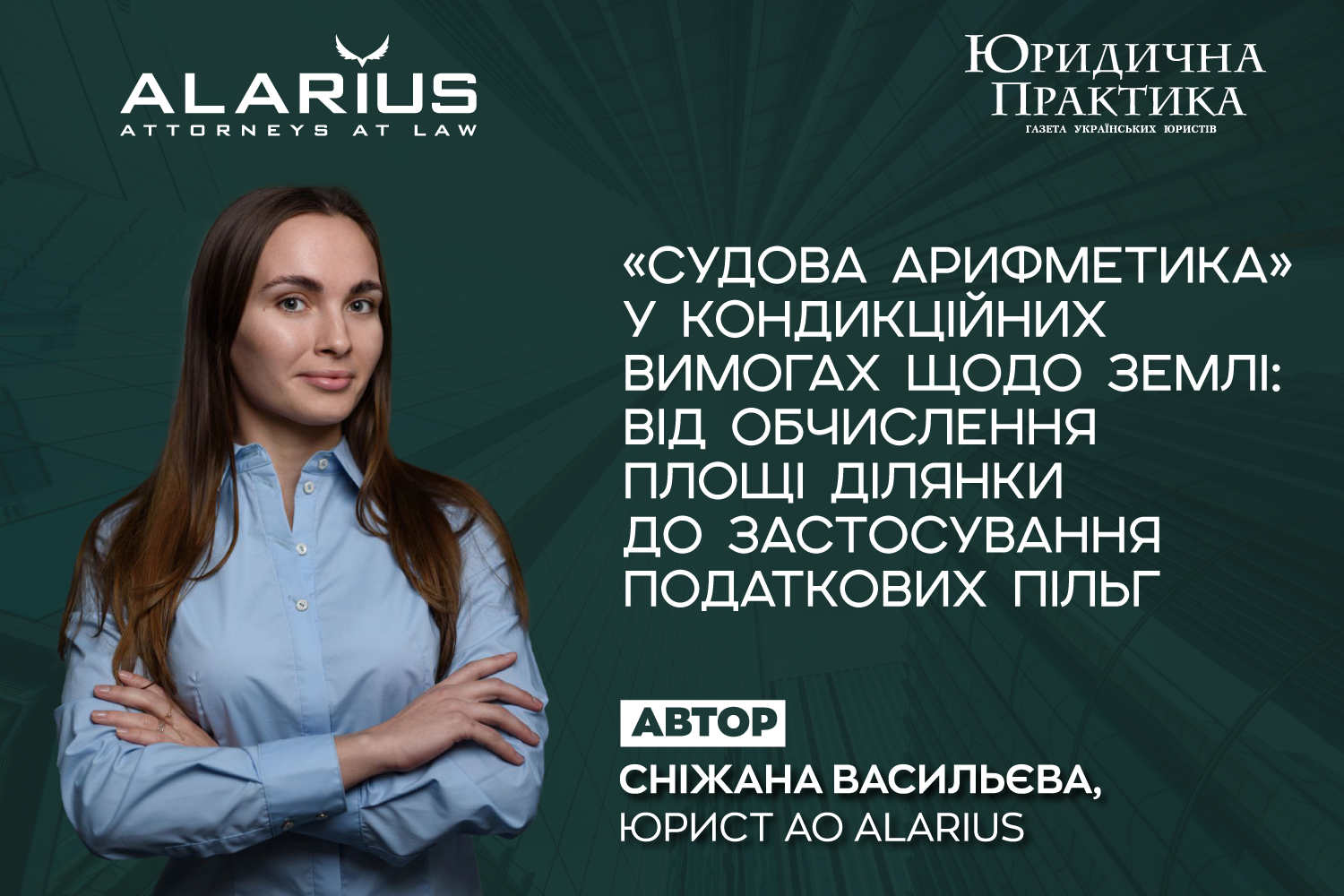
Snizhana Vasilyeva
Postgraduate student of the Educational and Scientific Institute of Law of Taras Shevchenko National University of Kyiv, lawyer of ALARIUS Bar Association, prepared material specifically for the newspaper “Yurydychnyy Bulletin of Ukraine”
The wholesale market of agricultural products by its legal nature is an infrastructural “node” of the agrarian market, designed to ensure the wholesale circulation of products, its concentration and reduction of logistical losses. This directly follows from the goals and directions of activity enshrined in the Law of Ukraine “On Wholesale Markets of Agricultural Products”, in particular, to accelerate the promotion of products from the producer to the final consumer. During the martial law, when supply chains are disrupted, the geography of production and consumption changes, and part of the territories suffers destruction or restrictions on access to agricultural products, the stability of such “nodes”, including directly depends on the legal certainty of the mechanism for regulating the lands of wholesale markets for agricultural products, which are as legal as well as the actual basis of the agrarian business.
At the same time, the legal provision of the status of the land of wholesale markets of agricultural products is still fragmentary and superficial: the special Law of Ukraine “On wholesale markets of agricultural products” devoted only to the land aspect by Article 12, which refers in abstract wording to the “order defined by law”, and the Land Code of Ukraine (hereinafter referred to as the ZC of Ukraine) also does not establish special rules for the circulation of land in wholesale markets of agricultural products. The above shortcomings of legislative regulation become prerequisites for litigation and attention of law enforcement agencies to agricultural producers, which can significantly affect or even block their economic activities. One of the reasons for such disputes is the problem of determining the target purpose of land of wholesale markets for agricultural products, which will be discussed further.
It should be noted that the use of land for its intended purpose is a direct obligation of landowners and land users, while the legal regime of the category of land determined in accordance with Articles 19, 20 of the ZC of Ukraine is decisive in deciding the issue of (non) purposeful use of land. Also, within each category of land, the legislator has defined independent types of purpose, which are formalized in the codes of the Classifier of Types of Targeted Land Plots (Appendix 59 to the Procedure for Maintaining the State Land Cadastre). In addition, the even narrower concept of “type of use” is still used in practice, which refers literally to the specific purpose formulated in the relevant decision of the managing body, with which the land was transferred into the ownership or use of a person. To change the category/type of intended purpose of the land plot of communal or state property, the ZK of Ukraine provides for a mandatory procedure through the approval of a previously agreed land management project by an authorized body of state power or a local self-government body, but the procedure for changing only the type of use without changing the category of land by the current legislation the decision does not establish what is expressly stated in the resolution of the Grand Chamber of the Supreme Court of 01.06.2021 in case No. 925/929/19. If the current version of the ZC of Ukraine does not operate at all with the concept of “type of use”, then in the previous edition, part five of Article 20 of the ZC of Ukraine, it was assumed that the types of use (except agricultural land and defense land) are determined by its owner or user independently. Therefore, for agricultural land there is a “special” stricter rule: use — only within the limits of the requirements of a specific type, defined in articles 31-37 of the Civil Code of Ukraine.
Criteria to be taken into account when determining the “correct” code of the type of target destination of land wholesale markets for agricultural products
Since the code of the type of purpose of agricultural land is determined on the basis of the materials of land formation and the decision of the managing body, which contains the wording of a specific type of use, it is advisable to investigate what the administrative and judicial authorities are guided by when determining whether the developers of documentation with land management are correct. and the bodies of the State Geocadastre determined the “code” of the type of destination.
Land plot formation materials and title documents as the primary “source” of the intended purpose of land
Administrative authorities and courts check which type of intended purpose of the land plot is enclosed in:
· decision of the managing body on the grant/removal/transfer of the land plot to municipal/state ownership;
· land management documentation (land management project, technical documentation, etc.);
· preliminary extracts from the DZK and other primary title documents that existed before the acquisition of property rights to the land at the time of its formation.
In this context, the resolution of the CAS of the Supreme Court of Ukraine of 03.04.2025 in case No. 600/5817/21-a, where the Supreme Court explicitly noted that during the formation of a land plot, the determination of its type of purpose is carried out by the developer of land management documentation (taking into account the decision of the authorities/local self-government on granting permission for the development of documentation on land management)
Information of the State Land Cadastre as an official, but refuted “source” of the intended purpose of land
The Administrative Court of Cassation in its decision of 22.02.2024 in case No. 120/5760/21-a noted that information on the intended purpose of the land plot is made on the basis of the submitted land management documentation in the DZC, and the DZK itself is the official source of such information.
At the same time, in the decision of the Administrative Court of Cassation dated November 7, 2023 in case No. 400/4165/21, the Court explicitly stated the presumption: the DZK's information is official and is considered reliable unless proven otherwise by the court.
The most typical proper and admissible evidence to refute DBC information (depending on what exactly is refuted):
1) the opinion of the judicial expert will become an effective tool in disputes about the coordinates of turning points, boundaries; overlaying of plots; quantitative characteristics of the site; compliance of actual land use/fences/roads with coordinates in the DZ; technical errors in geodata;
2) land management materials and primary land engineering documentation (land management project for diversion; technical documentation with land management; coordinate catalogs, outlines, field measurement logs; XML exchange files submitted for entering information to the DZK (if available); materials of approvals (acts of agreement of boundaries with neighbors) to refute incorrect data of the DZK on the qualitative and quantitative characteristics of the land plot;
3) title documents for the land plot (decision on the grant/transfer of the plot, approval of land management documentation; state acts (old model), lease/ superfiction/emfitevsis agreements, additional agreements, court decisions establishing or recognizing the right or determining the right area or area) to refute inaccurate information of the DZK about the legal regime of the land plot (purpose, form of use, grounds for acquisition):
4) data of topographic and geodetic works and the actual drawing of boundaries in nature (acts of drawing boundaries in nature; geodetic reports of certified geodetic engineers/surveyors; schemes/plans with coordinates in the state coordinate system; comparative plans of overlaying) in disputes concerning the actual and legally defined boundaries of the land plot;
5) other official cadastre/cartographic sources (land inventory materials; materials on the formation of the boundaries of settlements/territorial communities; approved zoning plans/master plans) for disputes about the possibility of a certain type of land use.
In addition, the legislation of Ukraine allows a completely free administrative (non-judicial) procedure for correcting errors in the information of the State Land Cadastre regarding the intended purpose of the land plot in the absence of litigation and recognition by both the land user and the State Geocadastre body of errors and inaccuracies compliance of the information of the DZK with the materials of the formation of the corresponding site. Such correction in the information of the DLC is carried out by the state cadastral registrar (the body that carries out the maintenance of the DLC).
It is necessary to distinguish two types of errors in the information of the DBC:
1) technical error “insertion/display” (description, incorrect data transfer, duplication, arithmetic/technical error, etc.), when the correct data is confirmed by documents, but is displayed differently in the PCB;
2) an error in the primary documentation, when incorrect data is included in the land management documentation. In this case, first correct the documentation, and only after that — the information in the DZK.
So, the grounds for correcting the information in the DZK are:
- identified a technical error in the data of the DLC (including in extracts/copies of documents generated from the DLC);
- an error made by the authority during the maintenance of the DZK/state registration of the site;
- an error caused by incorrect data in the land management documentation;
- error in information obtained through information interaction with other registers/system.
Depending on the situation, the procedure for correcting the error in the DBC can be initiated:
- notification/appeal of the detection of a technical error with the addition of documents confirming the correct data;
- a statement about the introduction of corrected/clarified information, if the error requires changes on the basis of corrected documentation or other grounds.
To successfully correct the error in the DZ, it is necessary to submit the document (s) that unequivocally confirm the correct information, depending on what exactly is being corrected:
- application/notification (in the prescribed form in the Procedure);
- a document containing the correct data (for example: proper documentation with land management; document on the basis of which information was entered; materials of the State Land Management Documentation Fund; or a court decision, if correction occurs on its basis);
- corrected/updated documentation (in case of incorrect information in the original version of the documentation and land management)
If we are talking about an error in the information of the DZK about the intended purpose/code of the KVCSPZ, as a rule, the body of the State Geocadastre will check: the decision of the manager, documentation with land management, primary materials of formation.
Other news
More news







.jpg)
.jpg)
.jpg)








.jpg)









.jpg)


Our Recognitions
.svg)


.svg)
.svg)
.svg)


.svg)
.svg)
Partners
.svg)
.svg)

.svg)
.svg)

.svg)


.svg)
.svg)
.svg)

